
Views: 169 Author: Site Editor Publish Time: 2025-09-15 Origin: Site


Lubrication plays a vital role in ensuring the smooth operation and longevity of mechanical systems. Its main function is to minimize friction between moving parts, which in turn reduces heat, wear, and energy loss. From automotive engines and industrial machines to aerospace equipment and electronics, lubrication is indispensable.
Two primary types of lubrication dominate modern industry: oil-based lubricants and solid lubricants. While oil lubricants have been the traditional choice for decades, solid lubricants have emerged as essential solutions for environments where oil-based lubricants cannot survive or perform adequately.
Oil-based lubricants primarily consist of base oils—either mineral oils refined from crude petroleum or synthetic oils engineered for specific performance—and additive packages that enhance their properties.
Oil lubricants create a viscous fluid film between two sliding surfaces, effectively separating them and preventing direct contact. This hydrodynamic film is critical for reducing friction and wear, particularly in systems where parts move at high speeds.
The viscosity of oil determines its film thickness and load-bearing capacity. Additives improve oxidation resistance, prevent corrosion, control foaming, and help manage temperature extremes. The oil continuously circulates through machinery, cooling components and carrying away contaminants.
Oil lubricants are ubiquitous in:
Automotive engines and gearboxes
mps and compressors
Hydraulic systems
Electric motors and turbines
Their fluid nature enables easy distribution and replenishment but also creates vulnerabilities in harsh or sensitive environments.
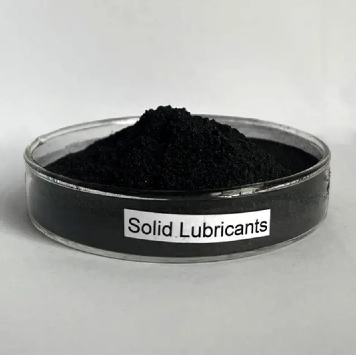
Unlike oils, solid lubricants are dry materials that reduce friction by forming a thin solid layer at the interface of moving parts.
Solid lubricants exist as powders, coatings, or embedded additives in composites. They do not rely on fluid films but create a low-shear tribological layer that enables smooth sliding even in the absence of liquids.
Graphite: Its layered atomic structure enables easy sliding of layers over one another, particularly effective in humid environments and stable up to ~500°C.
Molybdenum Disulfide (MoS₂): Known for excellent lubrication in vacuum and high-load conditions, functioning up to ~1100°C in inert atmospheres.
PTFE (Teflon): A chemically inert polymer with extremely low friction and stable performance up to 260°C.
Hexagonal Boron Nitride (h-BN): Offers excellent thermal conductivity and chemical stability at high temperatures.
Diamond-Like Carbon (DLC): Advanced coating with ultra-low friction and high hardness, ideal for wear resistance in demanding applications.
Oil lubricants form a continuous, viscous fluid film that separates contact surfaces, relying on hydrodynamic or elastohydrodynamic lubrication principles. This fluid film absorbs load and dissipates heat, protecting surfaces during high-speed operation.
Oil’s fluidity enables it to reach complex geometries and continuously renew the lubrication film. However, oils can thin out, degrade chemically, or be forced out of contact areas under extreme conditions.
Solid lubricants reduce friction through a different principle: the formation of a tribofilm, a thin solid layer adhering to surfaces. This film shears internally, preventing metal-to-metal contact. Layered solids like graphite and MoS₂ have weak interlayer forces allowing easy sliding, while polymers like PTFE slide due to their molecular chain structure.
Solid lubricants are effective in boundary lubrication regimes where fluid films fail, such as at low speeds, high loads, vacuum, or extreme temperatures.
One of the key distinctions between solid and oil lubricants lies in their operating temperature ranges. Oil lubricants generally perform effectively within a moderate temperature window, typically from –40°C up to around 150°C to 250°C, depending on their specific formulation. Beyond these limits, oils begin to degrade through oxidation and thermal breakdown. This degradation reduces their viscosity and ability to form a protective lubrication film, which can lead to increased friction, wear, and potential equipment failure. Consequently, oil lubricants are less suited for extreme high-temperature environments.
In contrast, solid lubricants can withstand substantially wider temperature ranges. For example, molybdenum disulfide (MoS₂) remains stable and effective at temperatures as high as 1100°C in inert atmospheres, while graphite functions well up to approximately 500°C in air. Hexagonal boron nitride (h-BN) can endure even higher temperatures, up to 1200°C, making solid lubricants indispensable in demanding applications such as aerospace, power generation, and heavy industry where extreme heat is common.
Oil lubricants face challenges in vacuum environments due to evaporation and outgassing, which cause the loss of their lubricating film. This makes oils unsuitable for space or vacuum applications. Solid lubricants, being non-volatile and chemically stable, maintain their lubricating properties under vacuum, radiation, and corrosive conditions, providing reliable friction reduction where oils fail.
Oil-based lubrication systems require regular monitoring, oil changes, and filtration to remove contaminants. The presence of impurities and oxidation products shortens oil life and increases the risk of machinery damage, leading to costly downtime. Solid lubricants, however, often provide long-lasting, maintenance-free lubrication, especially in sealed or hard-to-access parts, reducing operational costs and improving equipment uptime.
Oil leaks pose risks of environmental pollution, equipment damage, and safety hazards. Solid lubricants eliminate these risks as they do not leak or spill, making them ideal for sensitive environments like cleanrooms and medical device manufacturing, where contamination control is critical.
Spacecraft mechanisms experience vacuum, microgravity, and temperature extremes unsuitable for oils. Solid lubricants such as MoS₂ and DLC coatings enable reliable operation of satellite hinges, robotic arms, and scientific instruments.
Furnaces, kilns, and power plants operate at temperatures where oil lubricants degrade rapidly. Solid lubricants maintain low friction and protect components under prolonged thermal stress.
In these sectors, contamination control is paramount. Oil vapors or leaks could jeopardize product quality and safety. Solid lubricants offer dry, clean lubrication that meets stringent standards.
In mining, agriculture, and construction, oil attracts dust and grit, accelerating wear. Solid lubricants provide dry protection resistant to abrasive contamination.
Selecting between solid and oil lubricants requires careful consideration of:
Temperature: High-temp or cryogenic conditions favor solids.
Environment: Vacuum, radiation, or ultra-clean environments require solids.
Load and Speed: Heavy loads and low speeds suit solids; oils perform better at high speeds and moderate loads.
Maintenance Access: Limited access or sealed components benefit from solid lubricants’ long service intervals.
Material Compatibility: Some solids work better with specific metals or composites; oils may require additives for compatibility.
Application methods vary: solid lubricants can be applied as coatings (sprayed, dipped), powders, or embedded in composite materials.
Selecting the right lubricant is critical for ensuring machinery performance, durability, and operational efficiency. While oil lubricants serve many conventional uses, solid lubricants offer unmatched benefits in extreme environments—such as high heat, vacuum, and cleanroom conditions—where oils often fail. With advancements like nanocomposites and diamond-like carbon (DLC) coatings, solid lubricants now play a vital role across aerospace, automotive, electronics, and high-precision manufacturing industries.
For reliable, high-performance lubrication solutions, consider partnering with Dongying City Dayong Petroleum Additives Co., Ltd.As an expert in advanced lubrication materials, Dayong provides tailored solid lubricant products to meet your toughest engineering challenges. Visit their website to learn more or get in touch with their team for customized support.

